The question is whether flexographic printing can compete with offset printing and gravure in high-end packaging applications. Years of device development have answered that question.
The real decision is the volume of color. The key question is whether it is worth the cost of adding more printers when the standard four-color process is exceeded.
A played a prominent role in this decision. It provides a minimum number of printing plants that need to run a four-color process plus two dots of color. It also supports an expanded CMYK+OGV color range. It can also run a mixed workflow that combines process and spot colors. This allows the brand to colour more accurately, which is what high-end packaging is looking for at the moment.
Four-color printing (CMYK) can replicate about 55–60% of the visible light range under normal printing conditions using standard half-tone dot pattern. This level is sufficient for general printing needs. However, it's not enough for packaging that requires exact brand colours, Pantone matches, metallic effects, fluorescent colours, or accurate skin tones.
When the fifth and sixth printing stations are added, the range of colors increases significantly. A study published in Coloration Technology (2020) on expanded color gamut printing showed that adding orange and violet inks to CMYK increases the printable color range by about 25–35% (as measured by CIELAB).
For packaging, this is important when brand's colours go beyond CMYK. This includes strong reds, bright oranges, and deep purples, often used in food, cosmetics, and beverage brands. With the additional color stations, these colors can be replicated more accurately than only an approximation.
More than 90% of the Pantone library can be replicated using CMYK + O + V (cyan, magenta, yellow, black, orange, purple) on a Six Color Flexo Printing Machine. This reduces the need to mix special dots of ink. It also reduces the complexity of ink storage, shortens changeover time between jobs, while maintaining high color accuracy.
Uncompromising off-the-shelf Colour Capability
Alternative settings use CMYK plus two additional dot stations. This configuration is used for different types of production. In this model, the machine prints four color images and one or two special brand colors in the same pass. This is common in packaging factories that serve many different brands. Each brand usually needs its own exact color, and it has to fit the specifications every time.
The main technical challenge of the system is the accuracy of registration in all six printing houses. Smaller positional errors are introduced at each site. These errors may come from alignment of photopolymer plate mounted on cylinders, aniline oxidase rolls, or variations in web tension between sites.
ISO 12647-6:2012 establishes guidelines for flexographic printing. This requires that the positional difference between stations should be within ±0.10 mm to ensure high quality output.
Servo-driven automatic registration systems are required to achieve this accuracy at six sites. Manual adjustments are not enough, as small errors can accumulate from each site and affect the final print quality.
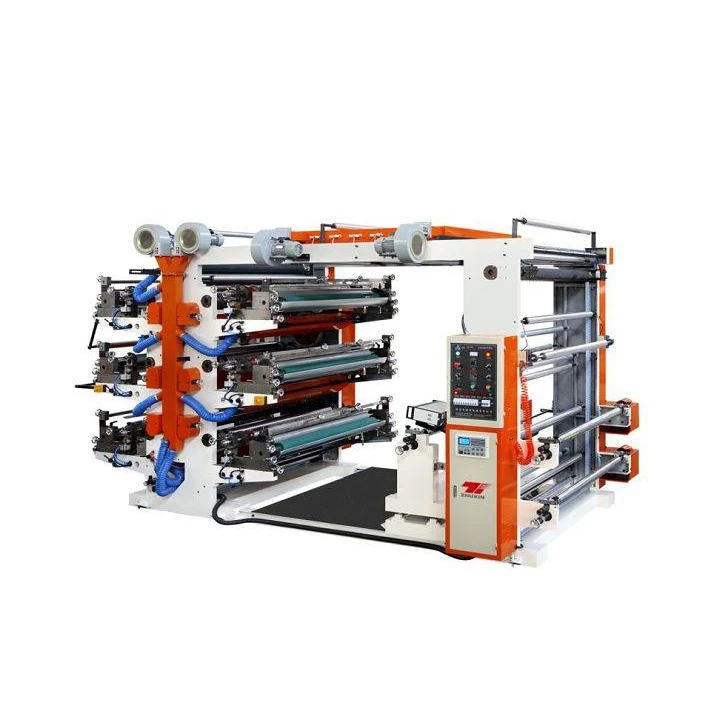
For brands that require a very accurate color palette for conversion work, a Six Color Flexo Printing Machine provides a practical solution. Four sites are used to process colors, and two are used to define key brand-point colors for the final appearance on shelves.
UV vs. Water-based Ink System: Six stops
The choice between ultraviolet curing inks and water-based inks impacts not only environmental requirements. This also affects the final print quality of each site.
UV-cured ink will dry immediately when exposed to UV light. This process creates a strong chemical film on the surface. Compared with water-based inks, the film has higher gloss, better scratch resistance and clearer details. ASTM D5264 provides a test method. In most cases, UV-cured prints last three to five times longer than water-based prints before significant wear and tear occurs.
However, UV systems are more costly, as each station requires UV lamps, cooling systems and ozone control equipment. UV inks also need to be good for dealing with materials exposed to ultraviolet light without causing damage such as yellowing or brittleness.
Water-based inks are still widely used in kraft paper, uncoated paperboard and some recycled materials. These materials absorb ink more easily. UV curing on these surfaces can make them too hard, which can cause problems later in life, such as folding, creasing or heat sealing.
Six stations can use both systems. Some sites can use UV inks to create high-detail images. Other sites can use water-based inks on absorbent materials. This hybrid setup is not possible on machines with four or fewer sites.
Substrate Range and High-end Packaging Combination
High-end packaging is not limited to one material. It can include elastic films such as BOPP, PET and PE laminate. It can also include folded cardboard, corrugated microflute lining, and special materials such as metallized films and holographic foil. These different materials are used in advanced packaging products.
Each material behaves differently in flexographic printing. This difference depends on surface energy, porosity, heat sensitivity, and the stability of the material during processing.
Six flexible printing presses designed for multiple substrates usually have adjustable pressure at each base station. It also uses different anilox rolls, usually ranging from 400 to 1600 lines per inch, depending on ink thickness and coverage. Between stations, it can include a drying system that can be used for IR drying, hot air, or UV curing depending on the material and ink type.
TAPPI T 559cm-96 provides a standard method for testing print durability. It helps to compare the abrasion resistance of different inks and substrate combinations.
When a six-stop machine can handle many different materials, its value increases. It can print with UV inks on soft film packaging or with water-based ink on paperboard cartons. This allows one machine to serve multiple product types. By contrast, four-stop packers often have fewer types of materials and cannot easily switch between different packaging markets.
Process Control Criteria for Defining "High-End"
"High-end packaging" is not just a marketing phrase. It refers to quality requirements set by industry standards.
A key requirement is accuracy of registration, which is defined by ISO 12647-6 as ±0.10 mm. Another important factor is dot gain control. In flexographic printing, dots increase because the printing plate is slightly soft and ink is transmitted through an anilox roll. This leads to a larger print dot than expected.
ISO 12647-6 sets a tone value increase (TVI) limit of ±3% for any color reference curve. In a six-color flexible printing press, each printer must control TVI separately. This is because different inks, anilox rolls, and coverage levels produce different dot gain behavior.
To manage this, modern machines use closed-loop spectrophotometric monitoring. The system measures color density during printing and automatically adjusts ink levels. This helps to keep the quality of the print stable at production speed.
Another requirement is uniform solid density. This refers to an area of pure color printed evenly across the width and length of the material. ISO 2846-1:2017 defines acceptable density range for process inks.
Printing is considered superior to specification if density varies too much, even within ±0.05 optical density units. Inline scanning densitometers on six printing presses can detect these changes early and reduce waste compared to manual checks.
Color accuracy is also measured using ΔE (Delta E), which shows the difference between the target color and the printed color. In the packaging industry, ΔE <= 1.0 is considered visually consistent, and ΔE <= 2.0 is usually the maximum acceptable level for high-end work.
ΔE <= 1.0 requires stable ink formulation, controlled ink transfer and consistent drying temperature. Modern six-stop printing presses with automated process control systems are more capable of maintaining these conditions than older machines without real-time feedback systems.
The additional cost of adding a fifth and sixth stop to a flexo printing machine is typically about 15 to 25 percent of the overall machine price. The exact cost depends on transmission, solidification and automation levels. Whether this extra cost is worth it depends on the type of production work.
In some cases, the six-stop setup offers significant economic benefits.
One example is brand diversity. Some converters work with five or more branded customers. In addition to processing colors, each brand needs one or two special spot colors. A six-stop machine can set these colors without changing the layout of the ink station. This reduces job changeover time for each assignment by about 20–40 minutes, increasing the production run time per shift.
Another scenario is expanded color gamut printing. When the company converts from spot color to CMYK+OGV system, the number of ink setups per job drops from about 8–12 inks to around 6 inks. This can reduce cleaning time and reduce ink waste caused by mixing. Factories that use extended-gamut workflows on six or more printers can boost productivity by about 15–25%, according to the Flexographic Technical Association.
The third condition is the softness of the substrate. Six machines can handle film, cardboard and special materials without major reconfiguration. This allows the same machine to do more types of jobs. With interchangeable anilox rolls and different curing options, the machine can serve multiple packaging markets while still using one production line.
The decision to invest in a Six Color Flexo Printing Machine for high-end packaging is not primarily about adding two additional printing stations. It's about gaining more flexibility in color usage, better process control, and the ability to print on more types of materials. These benefits come from combining additional sites with modern systems such as servo-driven registration, closed-loop density control and mixed curing systems.
Four presses are still suitable for basic packaging with low cost as the main objective. In this case, the unit price is more important than advanced printing quality or flexibility.
However, the requirements are different for converters working in the premium packaging market. They need accurate brand colours, a wider range of materials and stable production efficiency. In this section, the six-stop press is often the lowest setting to meet current market demand.
- U. Agarwal, & Gupta, R. "Printing with an extended color gamut of orange, green, and violet." Coloration Technology 136.3, 2020, pp 224-237. (CMYK+OGV gamut expansion, quantified in CIELAB units, percentage increase over standard CMYK, Pantone library coverage rate)
- ISO 12647-6:2012. Graphic technology - Process control for the production of half-tone colour separations, proof and production prints - Part 6: Flexographic printing. International Organization for Standardization, 2012. (Registration tolerance ±0.10 mm specification, tone value increase (TVI) control requirements, process control framework)
- ASTM D5264-98(2021). Standard practice for abrasion resistance of printed materials for Sutherland friction testers. ASTM International, 2021. (Test method for abrasion resistance on printed surfaces, UV curing or water-based film comparison data interpretation)
- ISO 2846-1:2017. Graphic technology - Colour and transparency of printing ink sets for four-colour printing - Part 1: Sheet-fed and web-fed offset printing. International Organization for Standardization, 2017. (Solid density uniformity specification, acceptable deviation thresholds, process ink density targets)
- TAPPI T 559cm-96. Print abrasion resistance of paper and paperboard. Technical Association of the Pulp and Paper Industry, 1996. (Test code for multi-substrate print durability, method for evaluation of substrate-ink combination)